11 May 2024
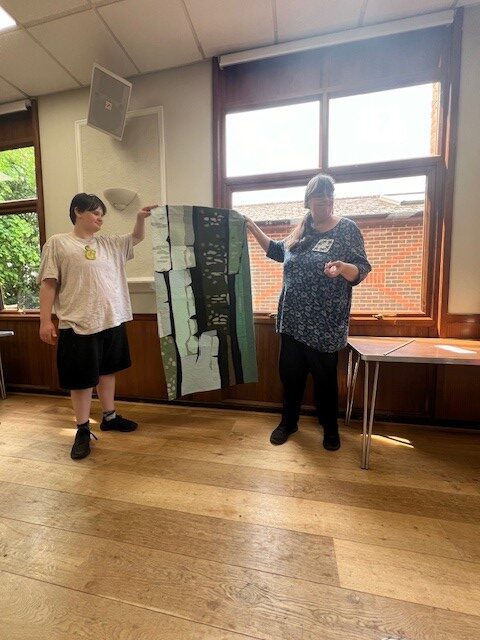
Today we had a fabulous day hosted by Vicki and Alec Worth. This morning, Vicki provided a show and tell of work produced during the Quilters’ Guild inaugural Master Quilter course.
The Master Quilter course came about after the Quilters’ Guild Region 2 (Surrey, Sussex, Kent) was generously gifted the stash of Mary Ann Corp by her husband, Lester Corp. This raised a serious amount of money (a lesson to all of us re our own stashes!).
It was aimed at ‘Journeyman quilters’ who
- Had been doing patchwork and quilting for at least two years
- Had developed an enthusiasm for furthering their skills and developing their practice
- Had a reasonable level of understanding of communication technology
- Were considering entering quilts into national shows
- Perhaps wish to pass their skills onto others
- Perhaps wish to pursue a degree in textile art at a later stage
In the first course, these were the modules:
- History of Patchwork and Quilting
- Precision Piecing
- Colour and Design
- Designing a Patchwork Quilt
- Curved Piecing
- Modern Quilts
- EPP and Fussy Cutting
- Creating Landscapes with Depth and Impact
- Appliqué
- Complex Piecing
- Colouring Cloth
- Machine Quilting with a Walking Foot
- Free Motion Machine Quilting
- Methods of Finishing a Quilt
- Piping and Binding
Some leading tutors headed up the different workshops, including:
- Judi Kirk
- Sara Cook
- Mandy Munroe
- Carolyn Forster
- Frances Silverman
- Tracy Aplin
- Catherine Lawes
- Gail Lawther
- Jennie Rayment
- Janet Bevan
- Philippa Naylor
- Heather Audin
Students had to:
- Attend the workshops for each module – these were held monthly with a choice of Surrey or Kent venues
- Make samples during the workshops
- Keep an artist’s journal
- Make a Journal Quilt (16.5” x 11.5” – i.e. roughly A3 sized) after each module’s workshop
Except:
- After the EPP and Fussy Cutting module they had to make a small quilt over the winter period.
- At the end of the course, a larger ‘Master Quilt’ for display at the following Region Two exhibition at Lullingstone was required (minimum 60” on the diagonal).
After a delay, due to Covid, the course began with a two-day introductory session at a Reigate hotel. After the submission of the Journal Quilt each month, feedback was provided by Liz Coleman and Judi Kirk.
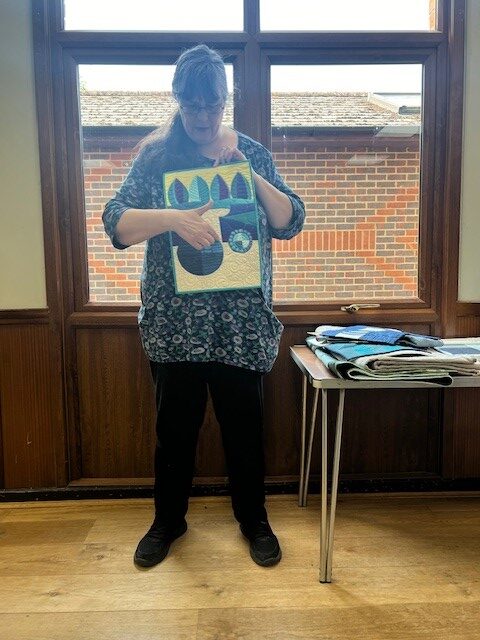
Vicki showed us many of her completed pieces and talked about her experience on the course. Sue Norgrove-Moore also showed some of her Master Quilt pieces, so it was interesting to see the different approaches to the same brief.
As it was the first time running the course, there have now been some changes to the structure (students who signed up to the first cohort were aware of their role as ‘testers’ and had the course fees heavily subsidised). During the first two years, the Quilters’ Guild organisers worked with Open Awards to make the course a recognised Level Three Accredited qualification. This meant students had to complete more paperwork than originally envisaged, a move not universally appreciated by all students, but worth it to get the qualification. Recently, the organisers have heard from the awarding body that they have recognised that the course is ‘low risk’ as the standard was so high. So, the current cohort will need to provide less written documentation. The second running of the course is now about halfway through.
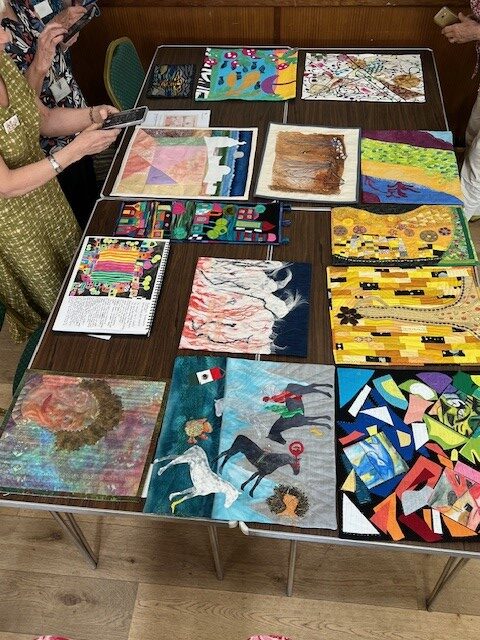
Just after lunch we had our Challenge reveal – Inspired by an Artist.
So, many members shared their completed and WIP for this challenge. We won’t show photos here as some of these will be on display at Lullingstone Quilt Show in July – do pop along and see them there. But here is a taster…
Afternoon workshop: Different Approaches to Design
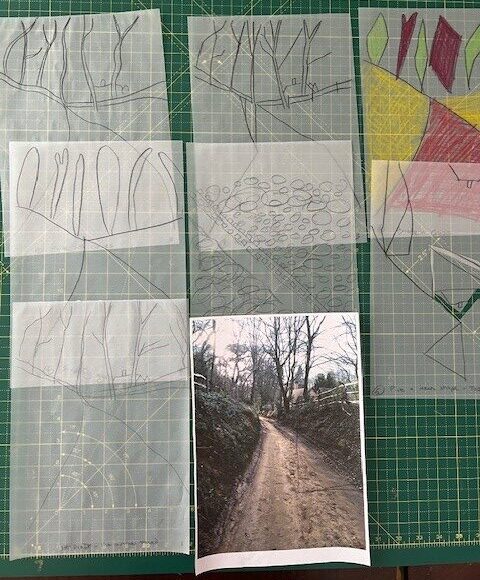
Our afternoon workshop, again run by Vicki Worth, had us all picking up pencils and paper to try out different approaches to designing our textile art. We selected a picture or photo and traced an outline of the main features. We then tried out many modifications of this initial tracing.
These included simplifying the core lines even further, making them angular, curvy, jagged, expanding upon a small area, blocking in colour, etc.
It really opened our eyes to many approaches and gave those of us not confident with drawing, a relatively straightforward way of diving in!
Thank you Vicki and Alec for another enjoyable and learning-filled CQ Surrey day.